Floral Cockatoo Graphics for Crafts
As someone who’s launched over 200 digital product listings across Etsy, Creative Market, and Shopify—and shipped thousands of printable designs and SVG bundles—I opened Floral Cockatoo with a very specific question: “Does this work *in context*?” Not just as a pretty file, but as a functional graphic design asset that holds up across real-world selling scenarios. Here’s what I found after testing it across mockups, thumbnails, print samples, and Cricut test cuts.
First Impression: Niche Clarity Meets Visual Warmth
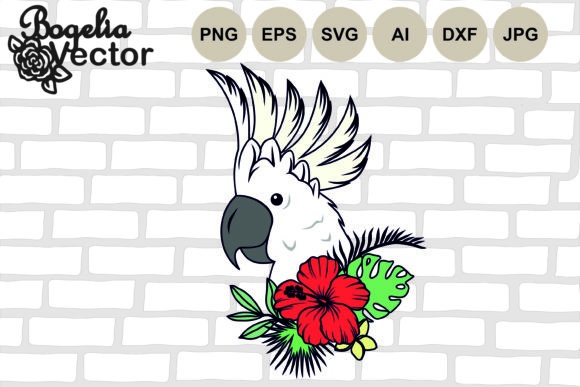
The moment you unzip the package, Floral Cockatoo delivers strong mood alignment—tropical but refined, playful without being juvenile, botanical but not overly delicate. It leans feminine and artisanal, with soft floral curves wrapping around a stylized cockatoo silhouette. Think coastal cottagecore meets modern tropical branding—not kitschy tiki, not clinical minimalism. That positioning matters: it appeals directly to Etsy shoppers searching for “bird svg shirts,” “nursery wall art,” or “tote bag prints” with botanical charm. It’s not bold enough for streetwear, nor intricate enough for fine-art giclée—but it’s perfectly calibrated for mid-tier digital downloads and small-batch merchandise.
Where It Shines in Real Product Workflows
I tested Floral Cockatoo across six high-traffic product categories—and here’s where it consistently added value:
- SVG products: Clean cut lines on both Cricut Design Space and Silhouette Studio; no stray nodes or overlapping paths. Ideal for layered vinyl projects like tumbler wraps or layered shirt graphics.
- Printable design bundles: Works beautifully in planner sticker sheets and greeting card sets—especially when paired with muted greens, coral, and cream palettes.
- Sublimation design: The balanced negative space and medium-detail florals hold up well on mugs, pillows, and tote bags at standard 300 DPI.
- Canva template integration: Scales cleanly into invitation suites and social media templates—its organic shape creates natural visual hierarchy without competing with text blocks.
- Digital download collections: Stands out in themed bundles like “Tropical Summer Printables” or “Bird Lover’s Planner Kit”—it’s distinctive enough to be a hero asset, but cohesive enough to share space with ferns, palm leaves, or hummingbirds.
- Product mockups: Delivers strong thumbnail appeal on Etsy and Creative Fabrica—its central focal point and light-to-medium contrast pop even at 200px width.
How It Strengthens Your Product Presentation
What makes Floral Cockatoo more than just another clipart file is how it supports perceived professionalism. When placed on a clean white mug mockup, it reads as intentional—not clipart-y. On nursery print previews, it adds warmth and narrative without cluttering the composition. In listing images, it helps establish brand identity: think consistent floral-animal motifs across your shop banner, product badges, and Instagram story highlights. That consistency builds trust, especially for buyers scanning dozens of similar listings. And because the illustration has clear positive/negative space, it translates well into packaging design—think sticker seals for gift boxes or labels for handmade soap.
Where to Use It With Intention (Not Assumption)
It’s not universally flexible—and that’s okay. I noticed limitations worth flagging before publishing:
- Avoid tiny sticker details: The inner flower clusters lose definition below 1.5 inches wide—so skip micro-sticker sheets unless you simplify manually.
- Test contrast on dark backgrounds: The original PNG has semi-transparent petals—on navy or charcoal mockups, some layers fade unless you adjust opacity or add a subtle drop shadow.
- Don’t force it into text-heavy layouts: Its organic flow competes with dense body copy. Better suited for headers, dividers, or standalone visual accents.
- Verify cut quality for intricate Cricut projects: While the main outline cuts cleanly, the smallest floral elements (like stamen dots) may require “weld” or “flatten” prep for reliable vinyl weeding.
Practical Seller Notes Before You List
Before adding Floral Cockatoo to your next Etsy product or Canva template pack, run these quick checks:
- Preview the SVG in Cricut Design Space *and* Silhouette Studio—confirm all layers separate cleanly and no hidden objects exist.
- Drop the PNG onto a white thumbnail and a dark one—see if edges hold up or need anti-aliasing tweaks.
- Print a test sheet at 100% scale on matte photo paper—check color fidelity, especially in the coral-pink florals.
- Open the files in Adobe Illustrator or Affinity Designer—verify transparency is preserved and no embedded raster elements weaken scalability.
- Organize customer-facing files clearly: name folders “SVG,” “PNG_300dpi,” “PNG_Transparent,” and include a brief license note confirming commercial use.
- Pair it intentionally with fonts: try a gentle serif (like Cormorant Garamond) for invitations, a friendly sans (Poppins) for social templates, or a relaxed script (Pacifico) for greeting cards.
Final Verdict: A Strategic Asset, Not Just Decor
Floral Cockatoo isn’t flashy—but it’s reliable. As a graphic design asset, it fills a precise gap: botanical charm with commercial readiness. It works hardest when used deliberately—not as filler, but as a unifying motif across printable design, SVG products, and brand-aligned merchandise. For sellers building seasonal collections (think “Spring Florals” or “Tropical Getaway Bundle”), it’s a smart anchor illustration. For Canva template sellers, it adds visual texture without sacrificing usability. And for crafters launching their first Cricut project line? It’s a low-risk, high-return starting point—provided you test it in context first.
If you’re curating digital downloads for creative marketplaces—or building a small business branding system around nature-inspired motifs—Floral Cockatoo earns its place. Not because it’s perfect, but because it’s purpose-built: a commercial design that supports your shop’s clarity, consistency, and quiet confidence.