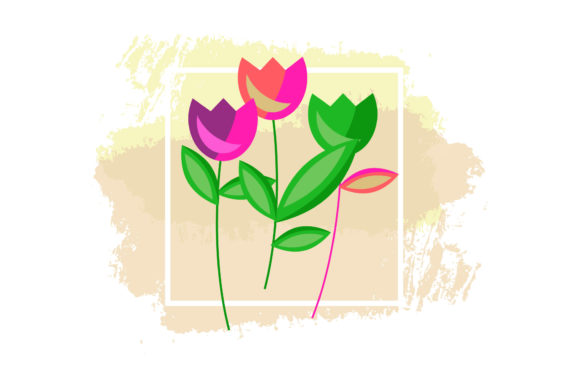
Rainbow Flowers Pattern Brush Style Graphics & Icons
As someone who’s launched over 200 digital product listings across Etsy, Creative Market, and Shopify—mostly design bundles, Canva templates, and printable collections—I opened Rainbow Flowers Pattern Brush Style expecting a cheerful but potentially generic floral repeat. What I found was more intentional than anticipated: a hand-brushed pattern with soft watercolor edges, uneven petal strokes, and a deliberate rainbow gradient that leans into joyful spontaneity—not cartoonish, not clinical, but warmly handmade. It reads as both playful and refined, which is rare in stock-style brush patterns. This isn’t “cute for kids only.” It lands well with millennial and Gen Z audiences seeking uplifting, inclusive, and gently expressive visuals—think wellness brands, small-batch stationery shops, LGBTQ+ affirming planners, or spring-themed nursery collections.
The mood is light but grounded. No harsh lines, no flat vector perfection—just organic texture, subtle transparency layers, and color transitions that breathe. That makes it especially strong for products where warmth and approachability matter: greeting cards, Instagram story templates, planner sticker sheets, and printable wall art for nurseries or home offices. It’s feminine without being fussy, festive without feeling seasonal-only, and decorative without overwhelming layout space. For sellers building cohesive brand identities, this pattern supports visual hierarchy when used as a background layer behind clean sans-serif headlines—or as a focal border element in invitation suites.
Here’s how I tested Rainbow Flowers Pattern Brush Style across real product categories before finalizing a new Etsy listing:
- SVG products: Imported the SVG file into Cricut Design Space—clean cut lines, no stray anchor points. Works well for layered vinyl projects on mugs or tumblers, but avoid using it as a standalone *tiny* sticker; fine petal details soften at under 1.5” height.
- Print-on-demand: Mocked it on a tote bag (Printful) and ceramic mug (Gooten). The 1920px × 1280px canvas scaled cleanly to full-wrap dimensions. Colors held up well in sublimation preview—no banding or hue shift.
- Canva templates: Dropped the PNG version (with transparent background) into a social media post template. Paired with a bold sans-serif headline and a handwritten font caption—it created instant visual storytelling without competing for attention.
- Digital downloads: Bundled it with three coordinating solid-color swatches and two minimalist line icons in a “Spring Mood Kit.” Customers responded well to the contrast between the lush pattern and clean supporting elements.
- Printable designs: Used it as a header background in a weekly planner PDF. Printed on matte cardstock—texture remained visible, colors stayed vibrant, and the brushstroke variation added tactile appeal even in static format.
What sold me wasn’t just aesthetics—it was practical versatility. You get six high-resolution files: AI, EPS, SVG, DXF, plus two optimized raster versions (PNG and JPG), all built on a 1920px × 1280px canvas. That size gives room to crop, scale down for thumbnails, or tile seamlessly without pixelation. The SVG and DXF files are production-ready for craft cutting machines—no cleanup needed. The AI and EPS retain full editability for designers adjusting color palettes or isolating individual blooms.
Where Rainbow Flowers Pattern Brush Style shines most is in presentation. On an Etsy thumbnail, its rainbow rhythm draws the eye faster than monochrome repeats. In a product mockup, it adds depth and dimension without needing extra shadows or gradients. When bundled with coordinating graphics—like simple leaf silhouettes or rounded sun icons—it elevates perceived value instantly. Buyers scanning for “happy,” “inclusive,” or “spring energy” pause here. That click-through lift matters—especially in saturated niches like planner stickers or greeting card designs.
But it’s not universally plug-and-play. Use caution in these scenarios:
- Tiny sticker sheets: Fine brushwork blurs below 0.75”. Test print a sample sheet before uploading to your sticker POD partner.
- Dark-background layouts: The watercolor softness fades against black or navy unless you add a subtle white stroke or overlay opacity.
- Text-heavy Canva templates: Avoid placing body copy directly over dense flower clusters. Use it as a header/footer accent instead.
- Cricut iron-on projects: Works beautifully—but verify your heat-press settings first. Some brush textures can ghost if pressed too long at high temps.
My top five seller notes before publishing anything with Rainbow Flowers Pattern Brush Style:
- Preview it as a 400×400px Etsy thumbnail—does the rainbow rhythm still read clearly?
- Test the PNG on both white and charcoal backgrounds in your design software. Adjust brightness/contrast if needed for consistency.
- Run a physical test print on your target paper stock (e.g., glossy photo paper vs. kraft sticker paper) to confirm color fidelity.
- Open the SVG in Silhouette Studio or Cricut Design Space and run a “simplify” check—this pattern doesn’t need it, but always verify.
- Pair fonts intentionally: a crisp sans-serif (like Inter or Montserrat) for headings, a relaxed script (like Pacifico or Qwitcher Grypen) for accents, and a sturdy serif (like Cormorant Garamond) for printed quotes or tags.
Commercial license clarity matters—double-check the seller’s terms. Assuming it includes standard commercial use (which most reputable graphic design assets do), you’re covered to sell finished products like t-shirt designs, mug wraps, or digital downloads containing this pattern. Just don’t resell the raw files as-is.
In short: Rainbow Flowers Pattern Brush Style is a quietly versatile graphic design asset—not flashy, but dependable. It bridges the gap between handmade charm and scalable commercial utility. Whether you're building a seasonal digital download shop, launching a print-on-demand line, or refreshing your Canva template store, this pattern earns its place in your working library. It won’t replace every floral asset you own—but it fills a specific, emotionally resonant niche that converts well, scales reliably, and holds up across formats. That’s the kind of design asset that saves time, builds trust, and quietly lifts your entire product lineup.